sonamarketify.com

Uncategorized

Google Ads Management Services: A Complete Guide to Growing Your Business

Google Ads Management Services: A Complete Guide to Growing Your Business In today’s competitive digital market, businesses need effective ways to reach potential customers and generate quality leads. Simply having a website is not enough. You need a strategy that connects your products or services with people who are actively searching for them. This is where Google Ads Management Services can help. Google Ads allows businesses to display advertisements across Google Search and other advertising placements. With the right campaign strategy, businesses can reach relevant audiences, attract website visitors, and generate enquiries. At Digital Empire, we believe that effective advertising starts with understanding your business goals, target audience, and budget. In this guide, we will explain how Google Ads Management Services work, their benefits, and how to build more effective advertising campaigns. What Are Google Ads Management Services? Google Ads Management Services involve planning, creating, monitoring, and optimizing advertising campaigns through Google Ads. These services help businesses manage their advertising budgets, select relevant keywords, write compelling ad copy, and measure campaign performance. Professional Google Ads campaign management may include: The main objective of Google Ads Management Services is to make advertising more strategic, measurable, and aligned with your business objectives. Why Does Your Business Need Google Ads Management Services? Running advertisements without a clear strategy can result in wasted spending and irrelevant website traffic. Businesses need to understand who they want to reach, what they want to promote, and how campaign success will be measured. Here are some important benefits of using Google Ads Management Services. 1. Reach Potential Customers at the Right Time Google Search Ads can help businesses reach people who are actively searching for relevant products or services. For example, someone searching for digital marketing services may already be exploring options for their business. With well-planned Google Ads Management Services, businesses can target relevant search terms and create ads that match users’ needs. 2. Generate Quality Leads For service-based businesses, advertising can help generate enquiries, consultation requests, and phone calls. Effective Google Ads Management Services focus on reaching relevant audiences and guiding them toward a clear action. A well-designed landing page, relevant ad copy, and a simple enquiry form can help improve the user journey from clicking an ad to submitting an enquiry. 3. Control Your Advertising Budget Google Ads allows advertisers to set budgets and choose bidding strategies based on their campaign objectives. Professional Google Ads Management Services help businesses review campaign spending, monitor cost per lead, and identify opportunities to use their budgets more effectively. However, campaign results depend on competition, targeting, landing page quality, and other factors. No advertising strategy can guarantee a specific number of leads or sales. 4. Measure Campaign Performance One of the key advantages of digital advertising is the ability to measure performance. With appropriate tracking, Google Ads Management Services can help businesses understand metrics such as: These insights help businesses make informed decisions and improve campaign performance over time. Types of Google Ads Campaigns Choosing the right campaign type is an important part of an effective advertising strategy. The best option depends on your audience, business goals, and available resources. 1. Google Search Ads Search Ads appear in Google search results when users search for relevant terms. They are useful for businesses that want to reach people actively looking for specific products or services. For example, a business offering SEO services may target relevant searches related to SEO packages or digital marketing solutions. 2. Google Display Ads Display Ads can show visual advertisements across eligible websites and apps in Google’s Display Network. They can help businesses build brand awareness and reconnect with relevant audiences through suitable targeting strategies. 3. Google Shopping Ads Shopping Ads display product information, such as images and prices, for eligible products. They are particularly useful for e-commerce businesses that want to promote products to potential buyers. 4. YouTube Video Ads YouTube advertising allows businesses to promote video content to relevant audiences. These campaigns can support brand awareness, product education, and other marketing objectives. 5. Performance Max Campaigns Performance Max campaigns use Google’s automation to help advertisers reach customers across eligible Google advertising channels through a single campaign. They can be useful when businesses have clear objectives, suitable creative assets, and reliable conversion tracking. Choosing the right campaign type is an important part of Google Ads Management Services because each format serves different marketing needs. How Google Ads Management Services Work A successful campaign requires more than creating an advertisement. It involves research, planning, testing, and continuous improvement. Step 1: Understand Your Business Goals The first step is identifying what you want to achieve. Your objective may be generating leads, increasing online sales, receiving phone calls, promoting a service, or building brand awareness. Clear goals help shape the campaign strategy. Step 2: Conduct Keyword Research Keyword research identifies the search terms potential customers use to find products and services. A Google Ads management strategy should consider search intent, keyword relevance, competition, and estimated advertising costs. For example, a business offering marketing services might research terms such as “Google Ads agency,” “PPC management services,” and “Google Ads management company.” Relevant keywords help connect advertisements with users who are more likely to be interested in the offer. Step 3: Create Relevant Ads Your advertisements should clearly communicate what you offer and why users should consider your business. Effective ad copy includes relevant messaging, a clear benefit, and a suitable call to action. Avoid misleading claims and make sure your ads match the content on the destination page. Step 4: Optimize the Landing Page A landing page should provide a consistent experience after someone clicks an advertisement. For effective Google Ads Management Services, the landing page should include: A relevant landing page can help visitors understand your offer and decide whether to contact your business. Step 5: Monitor and Improve Campaigns After launching a campaign, review performance regularly. Analyse search terms, spending, conversions, and audience behaviour to identify opportunities for improvement. Campaign adjustments may include refining keywords, adding
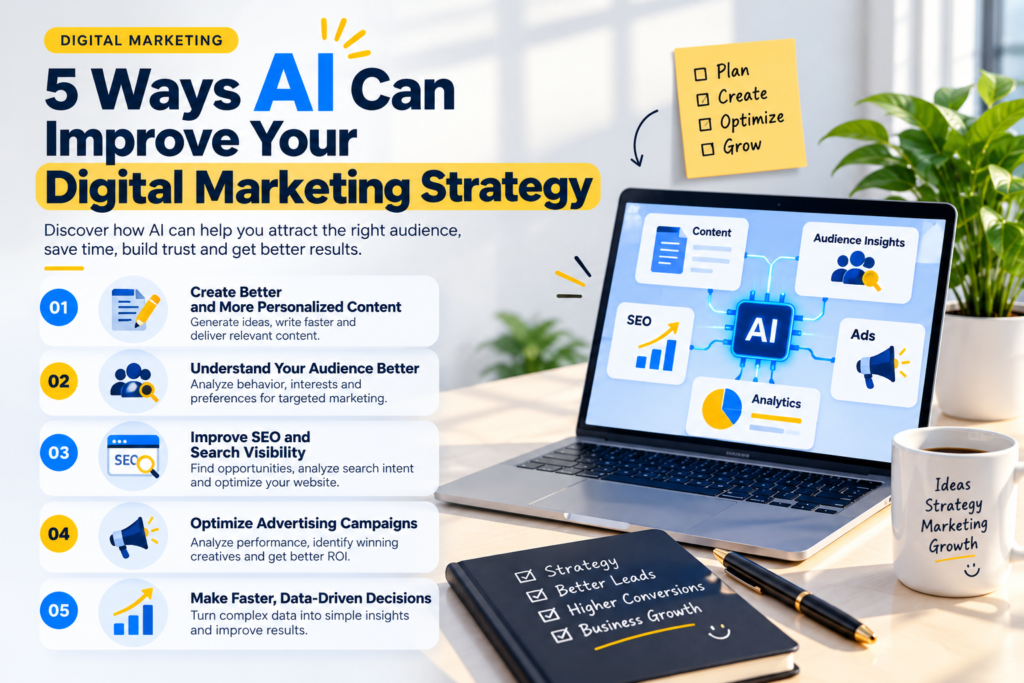
5 ways AI can improve your digital marketing strategy small business playbook
Uncategorized

AI Can Improve Your Digital Marketing Strategy

5 Ways AI Can Improve Your Digital Marketing Strategy (2026) Digital marketing used to be about guessing: guess the right audience, guess the right message, guess the right time to post. Today, artificial intelligence (AI) helps replace much of that guessing with data. If you want to work faster, spend smarter and connect better with customers, here are 5 ways AI can improve your digital marketing strategy, with practical examples you can start using this week. Why AI Matters in Digital Marketing Today Customers expect relevant messages, quick replies and a smooth experience across Google, social media, email and websites. Doing all this manually is slow and expensive, especially for small teams. AI tools can analyze large amounts of data, spot patterns and automate repetitive work. That frees you to focus on strategy, creativity and relationships, which are the parts of marketing machines still can’t do for you. The key point: AI supports your strategy; it does not replace it. You still need clear goals, a defined audience and human review. Way 1: Create Content Faster and Smarter Content is the base of SEO, social media and email. AI makes it faster to produce and easier to improve. How AI helps: Best practice: Always review AI drafts. Check facts, add real examples and rewrite in your brand voice. Content that is purely generic will not stand out, and may not rank. Way 2: Personalize Marketing at Scale People respond better to messages that feel made for them. AI makes personalization practical, even when you have thousands of customers. Examples: Better personalization usually means higher engagement, fewer unsubscribes and more repeat customers. Way 3: Optimize Ads and Reduce Wasted Budget Paid advertising can burn money quickly if it is not monitored. AI helps campaigns learn and improve continuously. How it helps: Tip: Give AI-driven campaigns good data. Accurate conversion tracking and clear goals matter more than any tool setting. Way 4: Make Better Decisions With Predictive Analytics Most marketers have plenty of data but little time to analyze it. AI turns reports into insights and predictions. What you can do: This helps you invest in what works and stop spending on what doesn’t. Way 5: Improve Customer Experience With Chatbots and Automation Speed matters. A potential customer who gets a reply in minutes is far more likely to stay engaged than one who waits a day. AI-powered chatbots and automation can: Use a chatbot as a helpful first responder, not a wall. Always give people an easy way to reach a real person. Quick Comparison: Where AI Helps Most Marketing Area How AI Helps Beginner-Friendly First Step Content Ideas, drafts, repurposing Use AI to outline your next blog post Personalization Segmentation, product suggestions Segment your email list by interest Advertising Bidding, creative testing Enable smart bidding with conversion tracking Analytics Predictions, lead scoring Use built-in insights in Google Analytics Customer service Chatbots, automation Add a simple FAQ chatbot or WhatsApp auto-reply Risks and Mistakes to Avoid AI is powerful, but misuse can hurt your brand. How to Get Started With AI in Your Marketing Frequently Asked Questions How can AI improve my digital marketing strategy? AI can improve your strategy by speeding up content creation, personalizing messages, optimizing ad spend, predicting customer behavior and providing faster customer support. The biggest gains come when you combine AI with clear goals and human judgment. Will AI replace digital marketers? AI is likely to change how marketers work rather than replace them entirely. It handles repetitive tasks and analysis, while people provide strategy, creativity, empathy and brand judgment. Is AI marketing suitable for small businesses? Yes. Many AI features are built into tools small businesses already use, such as Google Ads, email platforms and social media schedulers. Start with one simple use case and expand as you see results. Is AI-generated content good for SEO? It can be, if the content is accurate, helpful and edited by a human. Search engines care about quality and usefulness, not just how content was produced. Publishing unreviewed, generic content is risky. What is the best AI tool for digital marketing? There is no single best tool. The right choice depends on your goal: content, ads, email, analytics or customer support. Try free plans or trials and judge them by results. Conclusion These 5 ways AI can improve your digital marketing strategy (smarter content, personalization, ad optimization, predictive analytics and automated customer support) can help you save time, reduce wasted spend and understand your customers better. Start small, measure carefully and keep a human in the loop. The marketers who benefit most are the ones who treat AI as a smart assistant, not an autopilot. Want help building an AI-powered marketing plan for your business? [Contact us for a free strategy consultation.] 5 Ways AI Can Improve Your Digital Marketing Strategy Today (Small Business Playbook) SEO Details (copy into your CMS / Yoast / RankMath) Note on keyword overlap: If you also publish the earlier blog on this same focus keyword, the two pages can compete with each other in Google. Use a different URL for each, link them to each other, and consider switching this page’s focus keyword to “AI marketing for small business” if the first one is already ranking. Image Alt Text and Captions 5 Ways AI Can Improve Your Digital Marketing Strategy Today You do not need a big team or a big budget to use AI in marketing. Many small business owners already have the tools: a free chatbot, a spreadsheet, an email platform and a Google account. What is missing is a clear plan. This playbook shows 5 ways AI can improve your digital marketing strategy, with sample prompts you can copy, simple workflows and a 30-day plan to get started. Before You Start: Three Rules for Using AI in Marketing Way 1: Understand Your Customers Better Great marketing starts with knowing what your customers worry about, want and say. AI can help you read and summarize large amounts of feedback

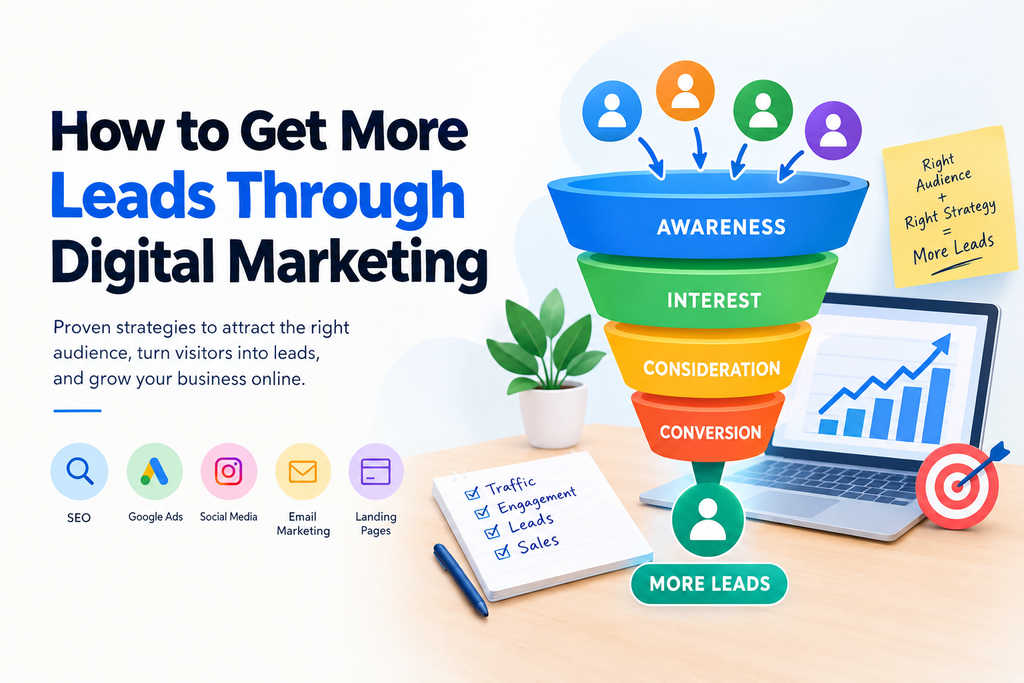
how to get more leads through digital marketing funnel diagram
Uncategorized

How to Get More Leads Through Digital Marketing (10 Proven Strategies for 2026)

How to Get More Leads Through Digital Marketing In today’s competitive online market, getting consistent leads is essential for business growth. Whether you run a small business, startup, service-based company, or e-commerce brand, digital marketing can help you reach the right audience and generate more qualified leads. But simply being present online is not enough. You need the right strategy, the right channels, and consistent optimization. If you are wondering how to get more leads through digital marketing, this guide will help you understand the most effective strategies you can use. What Are Digital Marketing Leads?https://www.wrike.com/digital-marketing-guide/faq/what-is-lead-generation-in-digital-marketing/ A lead is a person who shows interest in your business, product, or service and provides some form of contact information, such as a phone number, email address, or WhatsApp contact. For example, someone who: can become a potential lead. The goal of digital marketing is not just to increase website traffic but to convert the right visitors into potential customers. How to Get More Leads Through Digital Marketing? Here are some effective strategies to generate more leads online. 1. Build an SEO-Friendly Website Your website is one of the most important assets for lead generation. A well-optimized website helps your business appear when potential customers search for products or services related to your business. Focus on: For example, instead of targeting only a broad keyword like “digital marketing,” a business can target specific search terms such as “digital marketing agency in Varanasi” or “SEO services for small businesses.” This helps attract people who are more likely to become leads. 2. Use SEO to Attract High-Intent Traffic Search Engine Optimization (SEO) is a long-term strategy for generating organic leads. Create useful content around the questions your target customers are searching for. You can create: For example, a digital marketing agency can create content around topics such as how to get more leads through digital marketing, SEO strategies, Google Ads, social media marketing, and lead generation. The more relevant and helpful your content is, the more opportunities you have to attract potential customers through search engines. 3. Create High-Converting Landing Pages Sending all your advertising traffic to your homepage may not always generate the best results. Instead, create dedicated landing pages for specific campaigns. A good landing page should include: For example, if you are running an ad for a free digital marketing consultation, the landing page should focus specifically on that offer. 4. Use Google Ads for Faster Lead Generation SEO can take time to produce consistent results. Google Ads can help businesses reach people who are actively searching for their products or services. You can target keywords based on search intent and create ads that direct users to relevant landing pages. For better results: Google Ads can be especially useful when you want to generate leads for services with strong search demand. 5. Generate Leads Through Social Media Social media platforms such as Instagram, Facebook, LinkedIn, and YouTube can help businesses connect with potential customers. Instead of only posting promotional content, create content that solves problems and provides value. You can share: Add a clear CTA such as “DM us,” “Book a consultation,” “Get a free quote,” or “Visit our website.” This makes it easier for interested users to take the next step. 6. Use Lead Magnets A lead magnet is a free resource offered in exchange for a user’s contact information. Examples include: For example, a digital marketing agency could offer a “Free Digital Marketing Audit Checklist” and ask users to submit their email address to receive it. This can help turn website visitors into leads. 7. Improve Your Calls-to-Action A strong CTA tells visitors exactly what they should do next. Instead of using generic buttons such as “Submit,” try action-focused CTAs like: Your CTA should be visible and relevant to the page content. 8. Use WhatsApp for Lead Generation For many businesses, WhatsApp can be an effective channel for communicating with potential customers. Adding a WhatsApp button to your website and social media profiles makes it easier for visitors to start a conversation. Businesses can use WhatsApp to: The easier you make communication, the fewer opportunities you may lose. 9. Use Retargeting to Reach Interested Visitors Not every visitor will convert the first time they visit your website. Retargeting allows businesses to reconnect with people who have previously interacted with their website or digital content, where the relevant platform and privacy settings permit it. For example, someone may visit your service page but leave without submitting an enquiry. A well-planned retargeting campaign can remind them about your service and encourage them to return. 10. Track and Optimize Your Lead Generation Strategy One of the biggest advantages of digital marketing is that you can measure performance. Track metrics such as: Don’t simply focus on the number of leads. A campaign generating fewer but higher-quality leads may be more valuable than one generating many irrelevant enquiries. Common Mistakes That Can Reduce Leads Even with a good digital marketing strategy, some common mistakes can affect lead generation. Avoid: Small improvements in these areas can significantly improve your lead-generation process. How to Get More Leads How to Get More Leads Through Digital Marketing Most businesses don’t have a traffic problem. They have a leads problem. People may visit your website, scroll through your content, or see your advertisements, but many leave without sharing their phone number or email address. If this sounds familiar, you’re not alone. Generating traffic and leads remains one of the biggest challenges for marketers. In this guide, you will learn How to Get More Leads Through Digital Marketing with practical strategies that can help you attract the right audience, convert visitors into enquiries, and improve your overall lead-generation process. What Is Lead Generation in Digital Marketing? Lead generation is the process of attracting people who are interested in your products or services and encouraging them to share their contact information. A website visitor becomes a potential lead when they take an action such as: Leads can generally be divided into

Uncategorized

Best AI Tools for Digital Marketing: Boost Your Marketing Strategy in 2026

Artificial Intelligence is transforming the way businesses approach online marketing. From content creation and SEO to email campaigns and social media management, AI tools help marketers save time, improve productivity, and achieve better results. If you’re looking for the AI Tools for Digital Marketing, this guide will help you choose the right tools to grow your business. Why Use AI in Digital Marketing? AI-powered tools automate repetitive tasks, provide data-driven insights, and help marketers create high-quality campaigns faster. Whether you’re a freelancer, agency owner, or business owner, AI can improve your marketing performance while reducing manual work. Benefits of AI Tools Save time through automation Create high-quality content quickly Improve SEO performance Generate engaging social media posts Analyze marketing data with ease Increase leads and conversions Best AI Tools for Digital Marketing 1. ChatGPThttps://chatgpt.com/ ChatGPT is one of the most popular AI tools for creating blog posts, social media captions, ad copy, email campaigns, and marketing strategies. It helps marketers generate high-quality content in minutes. 2. Jasper AI Jasper AI is designed for businesses and agencies that need professional marketing copy. It is ideal for blogs, landing pages, advertisements, and product descriptions. 3. Canva AI Canva AI makes graphic design simple with AI-powered templates, image generation, background removal, and design suggestions. It is perfect for creating social media posts, presentations, and marketing creatives. 4. Surfer SEO Surfer SEO helps optimize website content for search engines. It provides keyword suggestions, content scores, and optimization recommendations to improve Google rankings. 5. Semrush AIhttps://semrush.com Semrush AI offers advanced keyword research, competitor analysis, backlink tracking, and SEO recommendations. It is one of the most powerful tools for digital marketing professionals. 6. Grammarly Grammarly improves grammar, spelling, tone, and readability, ensuring your marketing content looks professional and error-free. 7. HubSpot AI HubSpot AI simplifies email marketing, CRM management, lead generation, and customer engagement using intelligent automation. 8. Copy.ai Copy.ai quickly generates marketing copy, product descriptions, website content, and ad headlines, making content creation faster and more efficient. How to Choose the Right AI Tool When selecting the AI Tools for Digital Marketing, consider: Choose tools that solve your specific marketing challenges instead of using multiple platforms with overlapping features. Final Thoughts Using the AI Tools for Digital Marketing can significantly improve your productivity, content quality, SEO performance, and overall marketing results. Whether you’re creating blog content, running Google Ads, managing social media, or optimizing your website, AI tools help you work smarter and achieve better outcomes. Start with one or two AI tools, learn their features, and gradually expand your toolkit as your business grows. AI Trends That Are Transforming Digital Marketing in 2026 Artificial Intelligence is no longer limited to content generation. In 2026, AI is transforming every stage of the customer journey—from attracting visitors to converting them into loyal customers. Businesses using the AI Tools for Digital Marketing can make faster decisions, personalize customer experiences, and improve campaign performance with less manual effort. Some of the biggest AI trends include: How AI Improves SEO SEO has become more data-driven than ever. AI tools help marketers identify keyword opportunities, optimize content structure, and improve readability. AI Helps SEO By: Using the AI Tools for Digital Marketing alongside a solid SEO strategy can increase organic traffic and improve search engine visibility. AI for Social Media Marketing Managing multiple social media platforms can be time-consuming. AI tools simplify content planning, scheduling, and performance tracking. AI Can Help You: This allows marketers to maintain a consistent online presence while spending less time on repetitive tasks. AI in Google Ads and PPC Campaigns AI has significantly improved paid advertising by helping marketers make smarter decisions based on data. AI Can: Businesses using the AI Tools for Digital Marketing can create more effective advertising campaigns with better results. AI for Email Marketing Email marketing remains one of the highest-ROI digital marketing channels, and AI makes it even more effective.https://sonamarketify.com AI Features Include: These features help improve open rates, click-through rates, and conversions. AI for Lead Generation Generating quality leads is a top priority for every business. AI tools help identify potential customers, qualify leads, and automate follow-ups. AI Improves Lead Generation By: This results in a more efficient sales process and higher conversion rates. Common Mistakes to Avoid When Using AI While AI is a powerful assistant, relying on it without human review can lead to mistakes. Avoid these common errors: The best results come from combining AI efficiency with human creativity and expertise. Best Practices for Using AI in Digital Marketing To maximize the benefits of AI, follow these best practices: Future of AI in Digital Marketing Artificial Intelligence will continue to evolve, making marketing more personalized, automated, and data-driven. Businesses that adopt AI early will be better positioned to improve customer experiences, increase efficiency, and stay ahead of competitors. The AI Tools for Digital Marketing will become even more intelligent, offering deeper insights, faster automation, and more accurate predictions to help businesses grow in an increasingly competitive digital landscape. AI is changing the way businesses approach digital marketing. From SEO and content creation to paid advertising, social media management, email marketing, and lead generation, AI helps marketers achieve better results while saving valuable time. By choosing the AI Tools for Digital Marketing and using them strategically, businesses can build stronger marketing campaigns, improve customer engagement, and drive long-term growth. Industries That Benefit from AI Digital Marketing Tools Today, AI is helping businesses across almost every industry improve their marketing performance. Whether you’re a startup or an established enterprise, the AI Tools for Digital Marketing can simplify daily tasks and help you reach the right audience. E-commerce AI helps online stores recommend products, personalize shopping experiences, recover abandoned carts, and improve customer support. Healthcare Healthcare organizations use AI for appointment reminders, patient communication, email campaigns, and educational content. Real Estate Real estate agencies use AI to generate property descriptions, automate follow-ups, and qualify potential buyers. Education Educational institutions use AI to create course content, automate email marketing,

Scroll to Top
Call Now Button