
5 Ways AI Can Improve Your Digital Marketing Strategy (2026)
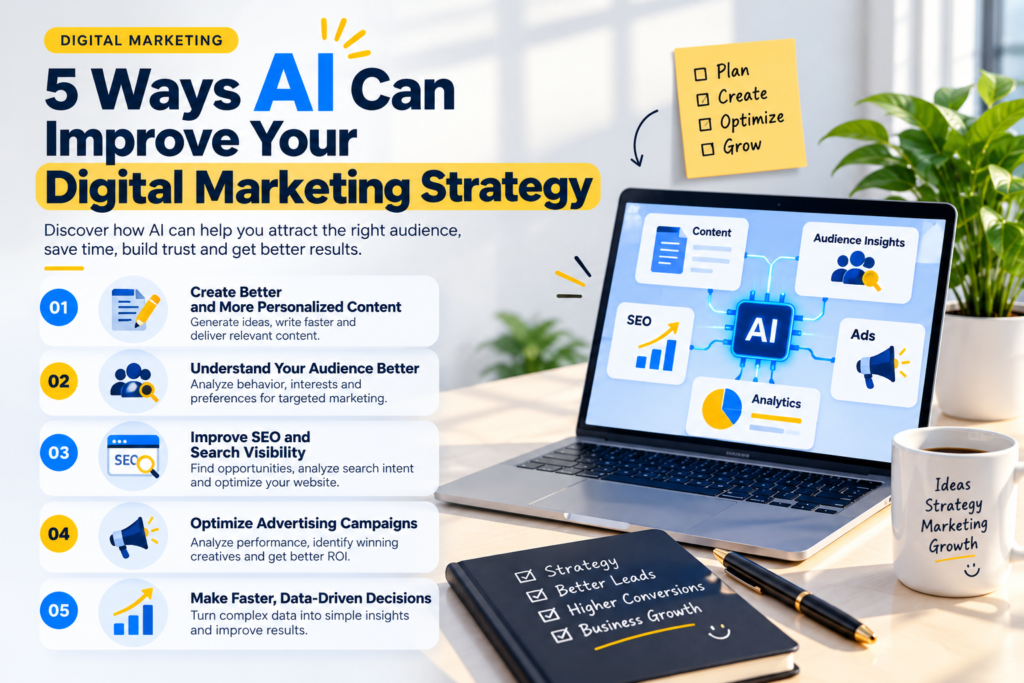
Digital marketing used to be about guessing: guess the right audience, guess the right message, guess the right time to post. Today, artificial intelligence (AI) helps replace much of that guessing with data.
If you want to work faster, spend smarter and connect better with customers, here are 5 ways AI can improve your digital marketing strategy, with practical examples you can start using this week.
Why AI Matters in Digital Marketing Today
Customers expect relevant messages, quick replies and a smooth experience across Google, social media, email and websites. Doing all this manually is slow and expensive, especially for small teams.
AI tools can analyze large amounts of data, spot patterns and automate repetitive work. That frees you to focus on strategy, creativity and relationships, which are the parts of marketing machines still can’t do for you.
The key point: AI supports your strategy; it does not replace it. You still need clear goals, a defined audience and human review.
Way 1: Create Content Faster and Smarter
Content is the base of SEO, social media and email. AI makes it faster to produce and easier to improve.
How AI helps:
- Idea generation: find topics, questions and angles your audience cares about.
- First drafts: create outlines, blog drafts, ad copy and social captions in minutes.
- Keyword research and optimization: suggest related keywords, headings and meta descriptions.
- Repurposing: turn one blog post into LinkedIn posts, email copy, scripts and short captions.
- Editing: improve grammar, tone and readability.
Best practice: Always review AI drafts. Check facts, add real examples and rewrite in your brand voice. Content that is purely generic will not stand out, and may not rank.
Way 2: Personalize Marketing at Scale
People respond better to messages that feel made for them. AI makes personalization practical, even when you have thousands of customers.
Examples:
- Email: send different subject lines, offers and content based on past behavior.
- Website: show different banners or recommendations to new visitors and returning customers.
- Product suggestions: recommend items based on browsing and purchase history.
- Send-time optimization: deliver emails when each person is most likely to open them.
- Audience segmentation: group customers by interest, stage or value instead of one broad list.
Better personalization usually means higher engagement, fewer unsubscribes and more repeat customers.
Way 3: Optimize Ads and Reduce Wasted Budget
Paid advertising can burn money quickly if it is not monitored. AI helps campaigns learn and improve continuously.
How it helps:
- Smart bidding: platforms like Google Ads and Meta adjust bids automatically based on conversion likelihood.
- Creative testing: compare many headlines, images and calls to action faster than manual A/B tests.
- Audience targeting: find look-alike audiences similar to your best customers.
- Budget allocation: shift spend toward the best-performing campaigns.
- Fraud and waste detection: flag suspicious clicks and low-quality placements.
Tip: Give AI-driven campaigns good data. Accurate conversion tracking and clear goals matter more than any tool setting.
Way 4: Make Better Decisions With Predictive Analytics
Most marketers have plenty of data but little time to analyze it. AI turns reports into insights and predictions.
What you can do:
- Predict lead quality: score leads by how likely they are to buy.
- Forecast results: estimate traffic, leads or revenue from different budgets.
- Spot trends early: notice rising topics, falling channels or unusual drops.
- Understand customer journeys: see which touchpoints lead to conversions.
- Reduce churn: identify customers who may leave, so you can reach out first.
This helps you invest in what works and stop spending on what doesn’t.
Way 5: Improve Customer Experience With Chatbots and Automation
Speed matters. A potential customer who gets a reply in minutes is far more likely to stay engaged than one who waits a day.
AI-powered chatbots and automation can:
- Answer common questions 24/7 on your website, WhatsApp or social media.
- Qualify leads by asking about needs, budget and timeline.
- Book appointments or demos automatically.
- Hand over to a human when the question is complex or sensitive.
- Trigger follow-ups, such as reminders, abandoned cart messages and thank-you emails.
Use a chatbot as a helpful first responder, not a wall. Always give people an easy way to reach a real person.
Quick Comparison: Where AI Helps Most
| Marketing Area | How AI Helps | Beginner-Friendly First Step |
|---|---|---|
| Content | Ideas, drafts, repurposing | Use AI to outline your next blog post |
| Personalization | Segmentation, product suggestions | Segment your email list by interest |
| Advertising | Bidding, creative testing | Enable smart bidding with conversion tracking |
| Analytics | Predictions, lead scoring | Use built-in insights in Google Analytics |
| Customer service | Chatbots, automation | Add a simple FAQ chatbot or WhatsApp auto-reply |
Risks and Mistakes to Avoid
AI is powerful, but misuse can hurt your brand.
- Publishing without review: AI can make factual mistakes or sound generic.
- Ignoring data privacy: follow privacy laws and be transparent about how you use customer data.
- Over-automation: too many automated messages feel impersonal.
- Chasing every tool: pick tools that solve a real problem rather than adding more complexity.
- No clear goal: decide what you want to improve (leads, sales, retention) before choosing a tool.
How to Get Started With AI in Your Marketing
- Pick one goal, such as more leads or lower cost per click.
- Choose one use case from the five above.
- Test with a small project, like one campaign, one email flow or one blog.
- Measure results against your previous performance.
- Scale what works and drop what doesn’t.
Frequently Asked Questions
How can AI improve my digital marketing strategy?
AI can improve your strategy by speeding up content creation, personalizing messages, optimizing ad spend, predicting customer behavior and providing faster customer support. The biggest gains come when you combine AI with clear goals and human judgment.
Will AI replace digital marketers?
AI is likely to change how marketers work rather than replace them entirely. It handles repetitive tasks and analysis, while people provide strategy, creativity, empathy and brand judgment.
Is AI marketing suitable for small businesses?
Yes. Many AI features are built into tools small businesses already use, such as Google Ads, email platforms and social media schedulers. Start with one simple use case and expand as you see results.
Is AI-generated content good for SEO?
It can be, if the content is accurate, helpful and edited by a human. Search engines care about quality and usefulness, not just how content was produced. Publishing unreviewed, generic content is risky.
What is the best AI tool for digital marketing?
There is no single best tool. The right choice depends on your goal: content, ads, email, analytics or customer support. Try free plans or trials and judge them by results.
Conclusion
These 5 ways AI can improve your digital marketing strategy (smarter content, personalization, ad optimization, predictive analytics and automated customer support) can help you save time, reduce wasted spend and understand your customers better.
Start small, measure carefully and keep a human in the loop. The marketers who benefit most are the ones who treat AI as a smart assistant, not an autopilot.
Want help building an AI-powered marketing plan for your business? [Contact us for a free strategy consultation.]
5 Ways AI Can Improve Your Digital Marketing Strategy Today (Small Business Playbook)
SEO Details (copy into your CMS / Yoast / RankMath)
- Focus Keyword: 5 ways AI can improve your digital marketing strategy
- Title Tag (58 chars): 5 Ways AI Can Improve Your Digital Marketing Strategy Today
- Meta Description (~145 chars): See 5 ways AI can improve your digital marketing strategy on a small budget, with sample prompts, free tools and a simple 30-day action plan.
- URL Slug: /ai-digital-marketing-strategy-small-business-playbook
- Secondary Keywords: AI for small business marketing, AI marketing prompts, free AI marketing tools, AI SEO workflow, AI social media planning
- Schema Suggestion: Article + HowTo + FAQPage
Note on keyword overlap: If you also publish the earlier blog on this same focus keyword, the two pages can compete with each other in Google. Use a different URL for each, link them to each other, and consider switching this page’s focus keyword to “AI marketing for small business” if the first one is already ranking.
Image Alt Text and Captions
- Featured image alt text: 5 ways AI can improve your digital marketing strategy small business playbook
- Featured image caption: A practical, budget-friendly way to start using AI in your marketing.
- Way 1 image alt text: AI customer research to improve digital marketing strategy
- Way 1 image caption: AI helps summarize reviews, comments and surveys into clear customer insights.
- Way 2 image alt text: AI SEO workflow for digital marketing strategy keyword clusters
- Way 2 image caption: Group keywords by intent so every page has a clear job.
- Way 3 image alt text: AI social media content calendar for digital marketing strategy
- Way 3 image caption: A 30-day content calendar can be drafted in under an hour.
- Way 4 image alt text: AI email and WhatsApp automation to nurture leads
- Way 4 image caption: Automated follow-ups keep leads warm without extra manual work.
- Way 5 image alt text: AI marketing report dashboard showing campaign performance
- Way 5 image caption: Plain-language reports help you decide what to do next.
5 Ways AI Can Improve Your Digital Marketing Strategy Today
You do not need a big team or a big budget to use AI in marketing. Many small business owners already have the tools: a free chatbot, a spreadsheet, an email platform and a Google account. What is missing is a clear plan.
This playbook shows 5 ways AI can improve your digital marketing strategy, with sample prompts you can copy, simple workflows and a 30-day plan to get started.
Before You Start: Three Rules for Using AI in Marketing
- Give context. AI gives generic answers to generic questions. Tell it your business, audience, location, offer and goal.
- Check everything. Verify facts, prices, claims and names before publishing.
- Keep your voice. Use AI for drafts and analysis, then edit so it sounds like you.
Way 1: Understand Your Customers Better
Great marketing starts with knowing what your customers worry about, want and say. AI can help you read and summarize large amounts of feedback quickly.
What to feed it:
- Customer reviews (yours and competitors’)
- Survey responses and form answers
- Questions from WhatsApp, Instagram DMs and email
- Sales call notes and common objections
Sample prompt:
“Here are 40 customer reviews for my [business type]. Summarize the top 5 reasons people buy, the top 5 complaints, and the exact words customers use. Then suggest 5 headline ideas for my website.”
Result: Better messaging, clearer offers and ads that sound like your customers, not like a brochure. Do not paste private customer data (phone numbers, addresses, payment details) into public AI tools.
Way 2: Build a Smarter SEO Workflow
SEO often gets ignored because it feels technical and slow. AI can speed up the planning side so you can focus on writing helpful pages.
How to use it:
- Expand keywords: ask for questions people search about your service.
- Cluster by intent: separate informational, comparison and buying keywords.
- Build outlines: create a structure that answers the search query completely.
- Write meta tags: draft title tags and descriptions, then check length and clarity.
- Suggest internal links: find related pages to connect.
Sample prompt:
“I run a [business] in [city]. Give me 30 search queries customers might type before buying, grouped by intent (learn, compare, buy). Suggest one page title for each group.”
Then confirm search demand in Google Search Console, Google Keyword Planner or a paid SEO tool. AI can guess; real data should make the final decision.
Way 3: Plan Social Media and Video Without Burning Out
Most small businesses do not fail at social media because of bad ideas. They fail because they run out of time. AI helps you plan and repurpose.
- Content calendar: generate a 30-day plan with topics, formats and calls to action.
- Repurposing: turn one blog or video into five social posts, a carousel outline and an email.
- Short video scripts: draft 30-second scripts for reels, shorts and stories.
- Captions and hashtags: create variations and test which performs better.
- Comment replies: draft helpful responses, then personalize them.
Sample prompt:
“Create a 4-week Instagram and LinkedIn plan for a [business] targeting [audience]. Include 3 educational posts, 1 customer story, 1 offer and 1 behind-the-scenes post per week. Add a call to action for each.”
Tip: Post fewer, better pieces. A realistic schedule you keep up beats an ambitious one you abandon.
Way 4: Automate Follow-Ups and Nurture Leads
Many leads are lost not because they were uninterested, but because nobody followed up. AI-assisted automation closes that gap.
Examples:
- Welcome sequences: write a 4-email series introducing your business and answering common questions.
- Abandoned cart or enquiry reminders: gentle nudges after a visitor stops.
- WhatsApp and website chat replies: quick answers to FAQs, hours, pricing and booking.
- Lead qualification: ask a few questions and route serious leads to your team.
- Re-engagement: write a campaign for customers who haven’t bought in 90 days.
Sample prompt:
“Write a 4-email nurture sequence for someone who downloaded my [lead magnet]. Goal: book a free consultation. Tone: friendly and professional. Include subject lines under 50 characters.”
Always include a clear way to reach a human, and respect opt-in and privacy rules in your country.
Way 5: Turn Reports Into Decisions
Analytics dashboards can overwhelm anyone. AI can explain what the numbers mean and what to do next.
You can:
- Paste a monthly summary (traffic, leads, cost per lead, conversion rate) and ask for the three biggest changes and likely causes.
- Compare two ad versions and ask which to scale and why.
- Ask for a plain-language summary to share with your team or boss.
- Create a to-do list based on the data.
Sample prompt:
“Here is last month’s marketing data: [paste numbers]. Identify what improved, what declined, and give me 5 specific actions for next month, ranked by effort and impact.”
Treat these answers as hypotheses. Test them before making big budget changes.
Your 30-Day Action Plan
| Week | Focus | What to Do |
|---|---|---|
| Week 1 | Customer insight | Collect reviews and questions; run the customer research prompt |
| Week 2 | SEO | Build a keyword list and outline your first 2 pages or posts |
| Week 3 | Social and email | Create a content calendar and a 4-email welcome sequence |
| Week 4 | Measure | Review results and choose one thing to scale and one to stop |
Common Mistakes to Avoid
- Publishing raw AI output. It can be bland, outdated or wrong.
- Sharing sensitive data. Remove personal and confidential information before using public tools.
- Using too many tools at once. Start with one tool and one workflow.
- Skipping measurement. If you can’t see results, you can’t improve.
- Forgetting the human touch. People still buy from people they trust.
Frequently Asked Questions
How can small businesses use AI in digital marketing?
Small businesses can use AI to research customers, plan SEO content, draft social posts and emails, automate follow-ups and summarize reports. Starting with one workflow, such as email or social planning, is the easiest way in.
Do I need paid AI tools to improve my marketing strategy?
Not necessarily. Free plans of popular AI assistants and built-in AI features in Google, Meta and email tools are enough to begin. Upgrade only when you hit a clear limit.
Can AI write all my marketing content?
AI can draft quickly, but it should not publish without review. Add your real experience, local details, examples and brand voice so the content is useful and trustworthy.
How long before I see results from using AI in marketing?
Time savings are usually immediate. Better leads, traffic and sales depend on the channel: ads can show results in days, while SEO and content often take a few months.
Is it safe to use customer data with AI tools?
Be careful. Avoid pasting personal or confidential data into public tools, check the privacy terms of any tool you use, and follow the data protection laws that apply to your business.
Conclusion
The 5 ways AI can improve your digital marketing strategy covered here (customer research, SEO workflow, social planning, automated follow-ups and smarter reporting) work best when you start small, use clear prompts and keep human judgment in charge.
Pick one way, test it for 30 days, and build from there.
Need help creating an AI-powered marketing plan for your business? [Book a free strategy call today.]
5 Ways AI Can Improve Your Digital Marketing Strategy TodayBloghttps://www.pgrmt.com/en/blog/5-ways-to-use-ai-in-digital-marketing-to-improve-your-strategy
You do not need a big team or a big budget to use AI in marketing. Many small business owners already have the tools: a free chatbot, a spreadsheet, an email platform and a Google account. What is missing is a clear plan.
This playbook shows 5 ways AI can improve your digital marketing strategy, with sample prompts you can copy, simple workflows and a 30-day plan to get started.
Before You Start: Three Rules for Using AI in Marketing
- Give context. AI gives generic answers to generic questions. Tell it your business, audience, location, offer and goal.
- Check everything. Verify facts, prices, claims and names before publishing.
- Keep your voice. Use AI for drafts and analysis, then edit so it sounds like you.
Way 1: Understand Your Customers Better
Great marketing starts with knowing what your customers worry about, want and say. AI can help you read and summarize large amounts of feedback quickly.
What to feed it:
- Customer reviews (yours and competitors’)
- Survey responses and form answers
- Questions from WhatsApp, Instagram DMs and email
- Sales call notes and common objections
Sample prompt:
“Here are 40 customer reviews for my [business type]. Summarize the top 5 reasons people buy, the top 5 complaints, and the exact words customers use. Then suggest 5 headline ideas for my website.”
Result: Better messaging, clearer offers and ads that sound like your customers, not like a brochure. Do not paste private customer data (phone numbers, addresses, payment details) into public AI tools.
Way 2: Build a Smarter SEO Workflow
SEO often gets ignored because it feels technical and slow. AI can speed up the planning side so you can focus on writing helpful pages.
How to use it:
- Expand keywords: ask for questions people search about your service.
- Cluster by intent: separate informational, comparison and buying keywords.
- Build outlines: create a structure that answers the search query completely.
- Write meta tags: draft title tags and descriptions, then check length and clarity.
- Suggest internal links: find related pages to connect.
Then confirm search demand in Google Search Console, Google Keyword Planner or a paid SEO tool. AI can guess; real data should make the final decision.
Way 3: Plan Social Media and Video Without Burning Outhttps://sonamarketify.com/lead-generation-services/
Most small businesses do not fail at social media because of bad ideas. They fail because they run out of time. AI helps you plan and repurpose.
- Content calendar: generate a 30-day plan with topics, formats and calls to action.
- Repurposing: turn one blog or video into five social posts, a carousel outline and an email.
- Short video scripts: draft 30-second scripts for reels, shorts and stories.
- Captions and hashtags: create variations and test which performs better.
- Comment replies: draft helpful responses, then personalize them.
Sample prompt:
“Create a 4-week Instagram and LinkedIn plan for a [business] targeting [audience]. Include 3 educational posts, 1 customer story, 1 offer and 1 behind-the-scenes post per week. Add a call to action for each.”
Tip: Post fewer, better pieces. A realistic schedule you keep up beats an ambitious one you abandon.
Way 4: Automate Follow-Ups and Nurture Leads
Many leads are lost not because they were uninterested, but because nobody followed up. AI-assisted automation closes that gap.
Examples:
- Welcome sequences: write a 4-email series introducing your business and answering common questions.
- Abandoned cart or enquiry reminders: gentle nudges after a visitor stops.
- WhatsApp and website chat replies: quick answers to FAQs, hours, pricing and booking.
- Lead qualification: ask a few questions and route serious leads to your team.
- Re-engagement: write a campaign for customers who haven’t bought in 90 days.
Sample prompt:
“Write a 4-email nurture sequence for someone who downloaded my [lead magnet]. Goal: book a free consultation. Tone: friendly and professional. Include subject lines under 50 characters.”
Always include a clear way to reach a human, and respect opt-in and privacy rules in your country.
Way 5: Turn Reports Into Decisions
Analytics dashboards can overwhelm anyone. AI can explain what the numbers mean and what to do next.
You can:
- Paste a monthly summary (traffic, leads, cost per lead, conversion rate) and ask for the three biggest changes and likely causes.
- Compare two ad versions and ask which to scale and why.
- Ask for a plain-language summary to share with your team or boss.
- Create a to-do list based on the data.
Sample prompt:
“Here is last month’s marketing data: [paste numbers]. Identify what improved, what declined, and give me 5 specific actions for next month, ranked by effort and impact.”
Treat these answers as hypotheses. Test them before making big budget changes.
Your 30-Day Action Plan
| Week | Focus | What to Do |
|---|---|---|
| Week 1 | Customer insight | Collect reviews and questions; run the customer research prompt |
| Week 2 | SEO | Build a keyword list and outline your first 2 pages or posts |
| Week 3 | Social and email | Create a content calendar and a 4-email welcome sequence |
| Week 4 | Measure | Review results and choose one thing to scale and one to stop |
Common Mistakes to Avoid
- Publishing raw AI output. It can be bland, outdated or wrong.
- Sharing sensitive data. Remove personal and confidential information before using public tools.
- Using too many tools at once. Start with one tool and one workflow.
- Skipping measurement. If you can’t see results, you can’t improve.
- Forgetting the human touch. People still buy from people they trust.
Frequently Asked Questions
How can small businesses use AI in digital marketing?
Small businesses can use AI to research customers, plan SEO content, draft social posts and emails, automate follow-ups and summarize reports. Starting with one workflow, such as email or social planning, is the easiest way in.
Do I need paid AI tools to improve my marketing strategy?
Not necessarily. Free plans of popular AI assistants and built-in AI features in Google, Meta and email tools are enough to begin. Upgrade only when you hit a clear limit.
Can AI write all my marketing content?
AI can draft quickly, but it should not publish without review. Add your real experience, local details, examples and brand voice so the content is useful and trustworthy.
How long before I see results from using AI in marketing?
Time savings are usually immediate. Better leads, traffic and sales depend on the channel: ads can show results in days, while SEO and content often take a few months.
Is it safe to use customer data with AI tools?
Be careful. Avoid pasting personal or confidential data into public tools, check the privacy terms of any tool you use, and follow the data protection laws that apply to your business.
Conclusion
The 5 ways AI can improve your digital marketing strategy covered here (customer research, SEO workflow, social planning, automated follow-ups and smarter reporting) work best when you start small, use clear prompts and keep human judgment in charge.
Pick one way, test it for 30 days, and build from there.