
How to Get More Leads Through Digital Marketing
In today’s competitive online market, getting consistent leads is essential for business growth. Whether you run a small business, startup, service-based company, or e-commerce brand, digital marketing can help you reach the right audience and generate more qualified leads.
But simply being present online is not enough. You need the right strategy, the right channels, and consistent optimization.
If you are wondering how to get more leads through digital marketing, this guide will help you understand the most effective strategies you can use.
What Are Digital Marketing Leads?https://www.wrike.com/digital-marketing-guide/faq/what-is-lead-generation-in-digital-marketing/
A lead is a person who shows interest in your business, product, or service and provides some form of contact information, such as a phone number, email address, or WhatsApp contact.
For example, someone who:
- Fills out your website form
- Sends you a WhatsApp message
- Requests a quotation
- Books a consultation
- Calls your business
- Downloads your free resource
can become a potential lead.
The goal of digital marketing is not just to increase website traffic but to convert the right visitors into potential customers.
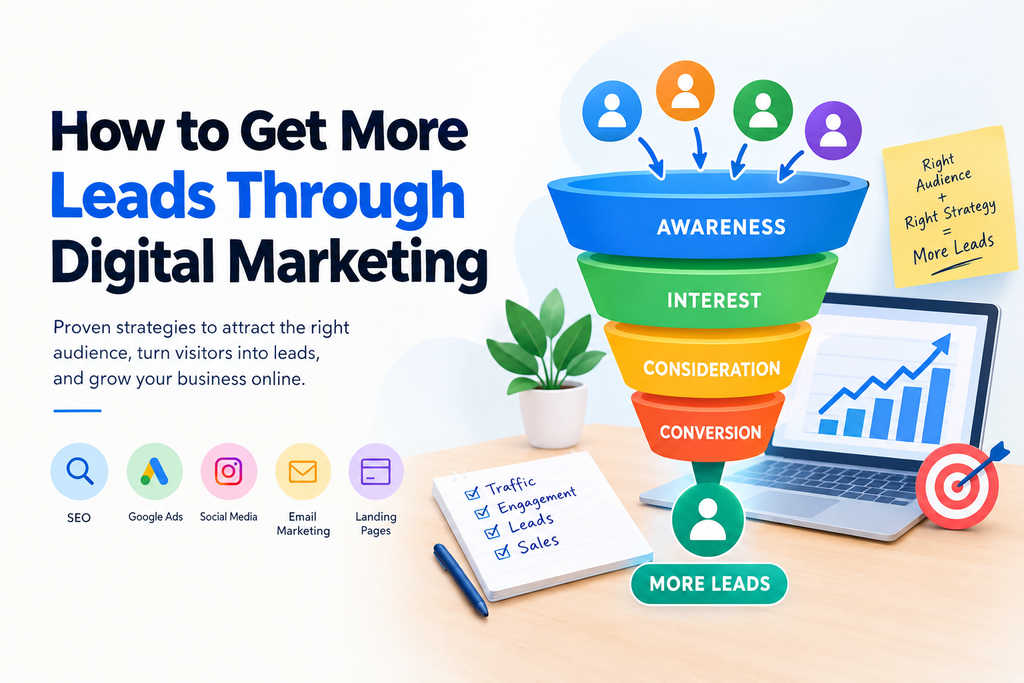
How to Get More Leads Through Digital Marketing?
Here are some effective strategies to generate more leads online.
1. Build an SEO-Friendly Website
Your website is one of the most important assets for lead generation.
A well-optimized website helps your business appear when potential customers search for products or services related to your business.
Focus on:
- Relevant keywords
- Clear website navigation
- Mobile-friendly design
- Fast loading speed
- Service-specific landing pages
- Strong calls-to-action
- Easy-to-use enquiry forms
For example, instead of targeting only a broad keyword like “digital marketing,” a business can target specific search terms such as “digital marketing agency in Varanasi” or “SEO services for small businesses.”
This helps attract people who are more likely to become leads.
2. Use SEO to Attract High-Intent Traffic
Search Engine Optimization (SEO) is a long-term strategy for generating organic leads.
Create useful content around the questions your target customers are searching for.
You can create:
- Blog posts
- Service pages
- How-to guides
- Case studies
- FAQs
- Comparison articles
For example, a digital marketing agency can create content around topics such as how to get more leads through digital marketing, SEO strategies, Google Ads, social media marketing, and lead generation.
The more relevant and helpful your content is, the more opportunities you have to attract potential customers through search engines.
3. Create High-Converting Landing Pages
Sending all your advertising traffic to your homepage may not always generate the best results.
Instead, create dedicated landing pages for specific campaigns.
A good landing page should include:
- A clear headline
- A strong value proposition
- Benefits of your service
- Social proof or testimonials
- Relevant images or visuals
- A simple enquiry form
- A clear CTA
For example, if you are running an ad for a free digital marketing consultation, the landing page should focus specifically on that offer.
4. Use Google Ads for Faster Lead Generation
SEO can take time to produce consistent results. Google Ads can help businesses reach people who are actively searching for their products or services.
You can target keywords based on search intent and create ads that direct users to relevant landing pages.
For better results:
- Target high-intent keywords
- Write relevant ad copy
- Use location targeting
- Add negative keywords
- Track conversions
- Test different campaigns
Google Ads can be especially useful when you want to generate leads for services with strong search demand.
5. Generate Leads Through Social Media
Social media platforms such as Instagram, Facebook, LinkedIn, and YouTube can help businesses connect with potential customers.
Instead of only posting promotional content, create content that solves problems and provides value.
You can share:
- Educational posts
- Short-form videos
- Customer testimonials
- Tips and tutorials
- Case studies
- FAQs
- Behind-the-scenes content
Add a clear CTA such as “DM us,” “Book a consultation,” “Get a free quote,” or “Visit our website.”
This makes it easier for interested users to take the next step.
6. Use Lead Magnets
A lead magnet is a free resource offered in exchange for a user’s contact information.
Examples include:
- Free checklist
- E-book
- Template
- Free consultation
- Industry report
- Marketing audit
- Free course or webinar
For example, a digital marketing agency could offer a “Free Digital Marketing Audit Checklist” and ask users to submit their email address to receive it.
This can help turn website visitors into leads.
7. Improve Your Calls-to-Action
A strong CTA tells visitors exactly what they should do next.
Instead of using generic buttons such as “Submit,” try action-focused CTAs like:
- Get a Free Consultation
- Request a Free Quote
- Book a Demo
- Get Started Today
- Talk to an Expert
- Download the Free Guide
Your CTA should be visible and relevant to the page content.
8. Use WhatsApp for Lead Generation
For many businesses, WhatsApp can be an effective channel for communicating with potential customers.
Adding a WhatsApp button to your website and social media profiles makes it easier for visitors to start a conversation.
Businesses can use WhatsApp to:
- Answer customer questions
- Share product or service information
- Follow up with enquiries
- Schedule appointments
- Provide quick support
The easier you make communication, the fewer opportunities you may lose.
9. Use Retargeting to Reach Interested Visitors
Not every visitor will convert the first time they visit your website.
Retargeting allows businesses to reconnect with people who have previously interacted with their website or digital content, where the relevant platform and privacy settings permit it.
For example, someone may visit your service page but leave without submitting an enquiry.
A well-planned retargeting campaign can remind them about your service and encourage them to return.
10. Track and Optimize Your Lead Generation Strategy
One of the biggest advantages of digital marketing is that you can measure performance.
Track metrics such as:
- Website traffic
- Conversion rate
- Cost per lead
- Click-through rate
- Lead quality
- Ad performance
- Landing page performance
- Return on ad spend
Don’t simply focus on the number of leads. A campaign generating fewer but higher-quality leads may be more valuable than one generating many irrelevant enquiries.
Common Mistakes That Can Reduce Leads
Even with a good digital marketing strategy, some common mistakes can affect lead generation.
Avoid:
- Targeting the wrong audience
- Using unclear CTAs
- Having complicated enquiry forms
- Ignoring mobile users
- Sending all traffic to the homepage
- Creating content without understanding search intent
- Not following up with leads
- Failing to track conversions
Small improvements in these areas can significantly improve your lead-generation process.
How to Get More Leads
How to Get More Leads Through Digital Marketing
Most businesses don’t have a traffic problem. They have a leads problem. People may visit your website, scroll through your content, or see your advertisements, but many leave without sharing their phone number or email address.
If this sounds familiar, you’re not alone. Generating traffic and leads remains one of the biggest challenges for marketers.
In this guide, you will learn How to Get More Leads Through Digital Marketing with practical strategies that can help you attract the right audience, convert visitors into enquiries, and improve your overall lead-generation process.
What Is Lead Generation in Digital Marketing?
Lead generation is the process of attracting people who are interested in your products or services and encouraging them to share their contact information.
A website visitor becomes a potential lead when they take an action such as:
- Filling out a contact form
- Booking a call
- Downloading a guide
- Requesting a demo
- Sending a WhatsApp message
- Signing up for an email list
Leads can generally be divided into different stages. Cold leads may have only discovered your brand, while warm leads have already interacted with your content. Marketing-qualified leads show stronger interest and may fit your ideal customer profile.
The goal is to move potential customers from awareness to interest and eventually toward conversion.
Step 1: Know Your Target Audienc/lead-generation-services/
Before investing in advertising or creating content, understand exactly who you want to attract.
Ask yourself:
- Who is your ideal customer?
- What problem are they trying to solve?
- Which platforms do they use?
- What prevents them from purchasing?
- What information do they need before making a decision?
The clearer your target audience is, the easier it becomes to create relevant content and campaigns.
Step 2: Build a Website That Converts Visitors Into Leads
Getting website traffic is only the first step. Your website should encourage visitors to take action.
Make sure your website has:
- A clear call-to-action
- Mobile-friendly design
- Fast loading speed
- Simple contact forms
- Testimonials and reviews
- Trust signals
- Click-to-call buttons
- WhatsApp enquiry options
Instead of using a generic CTA such as “Contact Us,” consider action-focused options such as “Get a Free Quote” or “Book a Free Consultation.”
A clear website journey can help turn visitors into enquiries.
Step 3: Use SEO to Attract High-Intent Visitors
Search Engine Optimization can help your business appear when potential customers search for solutions related to your products or services.
To use SEO for lead generation:
- Target keywords related to customer problems and buying intent.
- Create dedicated pages for important services.
- Optimize page titles, headings, and meta descriptions.
- Add internal links between relevant pages.
- Keep your content updated.
- Create a Google Business Profile if you serve a local audience.
SEO is generally a long-term strategy. It may take time to build rankings, but successful organic content can continue attracting visitors without paying for every click.
Step 4: Run Google Ads and Paid Campaigns
If you need to generate leads more quickly, paid advertising can help you reach people who are actively searching for your services.
Some useful options include:
- Google Search Ads
- Facebook and Instagram lead ads
- LinkedIn Ads
- Retargeting campaigns
Google Search Ads can be especially useful when people are already searching for a particular service.
For better results:
- Send visitors to a dedicated landing page.
- Test different ad variations.
- Monitor your cost per lead.
- Use relevant targeting.
- Remove irrelevant search terms from your campaigns.
Remember that getting clicks is not the same as getting leads. Your landing page and offer also need to convince visitors to take action.
Step 5: Create Lead Magnets
A lead magnet is a useful resource offered in exchange for a visitor’s contact information.
Some lead magnet ideas include:
- Checklists
- Templates
- Free audits
- Ebooks
- Industry reports
- Webinars
- Free consultations
- Quizzes
- Assessments
The best lead magnets solve a specific problem quickly.
For example, a digital marketing agency could offer a “Free Website SEO Audit” in exchange for a visitor’s name, email, and phone number.
You can promote your lead magnet through blog posts, social media, advertisements, pop-ups, and email campaigns.
Step 6: Use Email Marketing to Nurture Leads
Not every lead is ready to purchase immediately. Email marketing allows you to stay connected with potential customers until they are ready to make a decision.
A basic email nurturing process can include:
- A welcome email
- Educational content
- A case study
- Answers to common objections
- A relevant offer
You can also segment your audience based on their interests and behaviour so that your emails remain relevant.
The goal is to provide value rather than repeatedly sending promotional messages.
Step 7: Use Social Media to Build Trust
Social media can help businesses build awareness, credibility, and relationships with potential customers.
Different platforms can serve different purposes:
LinkedIn: Useful for B2B businesses and professional audiences.
Instagram and Facebook: Useful for reels, short videos, customer stories, and visual content.
YouTube: Useful for tutorials, educational videos, and detailed explanations.
Online communities: Useful for answering questions and demonstrating expertise.
Instead of only promoting your services, share useful information that helps your audience solve real problems.
Consistent and valuable content can make your business more trustworthy.
Step 8: Use Video and Webinars
Video is another effective way to communicate information and build trust.
Businesses can use:
- Explainer videos
- Client testimonials
- Product demonstrations
- Tutorials
- Live webinars
- Q&A sessions
Webinars can also generate qualified leads because people who register have already shown interest in a specific topic.
Make sure every video or webinar includes a clear next step, such as downloading a resource, booking a consultation, or requesting a demo.
Step 9: Track, Test, and Improve
One of the most important parts of lead generation is measurement.
Track metrics such as:
- Website visitors
- Lead conversion rate
- Cost per lead
- Lead-to-customer conversion rate
- Best-performing pages
- Best-performing advertisements
- Lead sources
Tools such as Google Analytics, Google Search Console, CRM systems, and UTM tracking can help you understand where your leads are coming from.
You can then test different headlines, CTAs, forms, landing pages, and offers to improve your results.
Why Am I Not Getting Leads?
If your website or campaigns are receiving attention but not generating enquiries, there may be a conversion problem.
Traffic but no enquiries
Possible problem: Weak CTA, slow website, or lack of trust signals.
Solution: Add clear CTAs, improve website speed, and include testimonials or reviews.
Ads get clicks but no leads
Possible problem: Wrong audience or an irrelevant landing page.
Solution: Improve targeting and create a dedicated landing page.
Many leads but no sales
Possible problem: Poor lead quality or slow follow-up.
Solution: Add qualifying questions and improve your follow-up process.
Leads go cold
Possible problem: There is no lead-nurturing process.
Solution: Use email or WhatsApp follow-up to stay connected with potential customers.
SEO traffic is low
Possible problem: You may be targeting highly competitive keywords.
Solution: Focus on more specific, long-tail, and problem-based keywords.
Quick Checklist for Lead Generation
To improve your lead-generation strategy:
- Define your ideal customer.
- Optimize your website for conversions.
- Create SEO content around relevant topics.
- Run targeted Google or Meta Ads.
- Create a useful lead magnet.
- Build an email nurturing process.
- Stay active on the platforms your audience uses.
- Track cost per lead and conversion rates.
- Test and improve your campaigns regularly.
Frequently Asked Questions
What is the fastest way to get leads through digital marketing?
Paid search advertising can generate leads quickly because it allows businesses to reach people who are already searching for relevant products or services. A focused landing page can further improve the conversion process.
How can I get leads without paying for ads?
You can focus on SEO, Google Business Profile, social media content, email marketing, community participation, and referrals. These methods generally require more time but can reduce dependence on paid advertising.
Which digital marketing channel is best for lead generation?
There is no single best channel for every business. SEO and Google Search can work well for high-intent searches, LinkedIn can be useful for B2B businesses, and email marketing is effective for nurturing existing leads.
How long does it take to get leads from digital marketing?
Paid advertising can start generating leads relatively quickly, while SEO and content marketing usually require more time to build consistent results.
How much should I spend on lead generation?
Your budget depends on your industry, target audience, average customer value, and marketing goals. Start with a manageable budget, measure your cost per lead, and increase spending on channels that generate profitable customers.
Conclusion
Learning How to Get More Leads Through Digital Marketing is not about relying on one marketing channel. It is about creating a complete system that attracts the right audience, builds trust, converts visitors, and nurtures potential customers.
Start by understanding your audience. Then combine strategies such as SEO, paid advertising, content marketing, social media, landing pages, lead magnets, and email marketing.
Most importantly, track your results and continuously improve your strategy. With the right approach, digital marketing can become a consistent source of relevant leads and business growth.
Ready to generate more leads? Start by choosing one strategy from this guide and optimize it consistently.
How to Get More Leads Through Digital Marketing: 10 Proven Strategies
Getting website visitors is great, but traffic alone does not grow a business. The real challenge is turning those visitors into people who enquire, book a call, request a demo, or make a purchase.
This is why businesses need a proper lead-generation strategy. If you are looking for How to Get More Leads Through Digital Marketing, you need to focus on more than just posting content or running advertisements. Your strategy should attract the right audience, build trust, and make it easy for potential customers to take action.
In this blog, we will explore 10 practical strategies that can help businesses generate better leads through digital marketing.
What Makes a Good Lead?
Before discussing lead-generation strategies, it is important to understand what makes a lead valuable.
A good lead is someone who:
- Has a genuine need for your product or service
- Matches your target audience
- Has shown interest in your business
- Has the potential to become a customer
Getting hundreds of random enquiries is not always better than getting a smaller number of qualified leads. The goal should be to attract people who are more likely to become paying customers.

1. Define Your Ideal Customer
The first step in How to Get More Leads Through Digital Marketing is understanding who you want to attract.
Create an ideal customer profile by considering:
- Age group
- Location
- Profession or business type
- Interests
- Problems and challenges
- Buying behaviour
- Budget
- Preferred communication channels
When you understand your audience, you can create more relevant advertisements, content, landing pages, and offers.

2. Create Content That Solves Problems
People search online because they need information or solutions.
Instead of only promoting your services, create content that answers the questions your potential customers are asking.
For example, a digital marketing agency could create content such as:
- How to improve website traffic
- How to generate leads online
- Common Google Ads mistakes
- How to improve social media engagement
- How to create a high-converting landing page
Helpful content can attract visitors and establish your business as a useful source of information.
3. Optimize Your Website for Conversions
Your website should not simply provide information. It should guide visitors toward the next step.
Add clear calls-to-action such as:
- Get a Free Consultation
- Request a Quote
- Book a Demo
- Talk to an Expert
- Download the Free Guide
Keep your forms simple and make sure visitors can easily contact you through mobile devices.
A website that is easy to understand and navigate can make a major difference in lead conversion.
4. Use SEO to Attract the Right Audience
SEO can help your business appear when potential customers search for information related to your products or services.
Focus on keywords that match different stages of the customer journey.
For example:
Informational:
“How does digital marketing work?”
Problem-based:
“How to get more website enquiries?”
Commercial:
“Best digital marketing agency for small business”
Transactional:
“Digital marketing services near me”
Creating content around these different search intents can help attract people at different stages of the buying journey.
5. Create a Strong Lead Magnet
A lead magnet gives potential customers a reason to share their contact information.
Some useful lead magnet ideas include:
- Free checklist
- PDF guide
- Marketing template
- Free consultation
- Website audit
- SEO audit
- Free webinar
- Marketing assessment
For example, a digital marketing agency could offer a free website audit. Visitors can enter their details to receive the audit, giving the business an opportunity to follow up with them.
6. Use Paid Advertising Strategically
Paid advertising can help you reach your target audience faster.
Google Ads can target people actively searching for products or services, while Meta Ads can help businesses reach specific audience groups on Facebook and Instagram.
However, successful advertising requires more than simply increasing the budget.
You should test:
- Ad headlines
- Images and videos
- Audience targeting
- Offers
- Landing pages
- Calls-to-action
Track your cost per lead and focus your budget on campaigns that generate relevant enquiries.
7. Use Social Media to Build Trust
Social media is not only for gaining followers. It can also help businesses build relationships with potential customers.
Share content such as:
- Educational reels
- Customer testimonials
- Case studies
- Behind-the-scenes content
- Tips and tutorials
- Industry insights
- Frequently asked questions
Consistent content can help people become familiar with your brand before they decide to contact you.
8. Add WhatsApp and Quick Contact Options
For many businesses, potential customers prefer quick communication instead of filling out long forms.
Adding a WhatsApp button, phone number, or quick enquiry option can reduce friction.
For example, a visitor reading your service page can click “Chat on WhatsApp” and immediately ask a question.
The easier you make communication, the fewer potential leads may drop off before contacting your business.
9. Follow Up With Your Leads
Generating a lead does not guarantee a sale.
Some people need more information before making a decision. Others may simply be comparing different options.
Create a follow-up process using:
- Phone calls
- Retargeting
- Helpful resources
Responding quickly can also improve the chances of continuing the conversation while the prospect is still interested.
10. Measure Your Results
The final part of How to Get More Leads Through Digital Marketing is measurement.
Without tracking, you cannot know which strategies are actually working.
Monitor metrics such as:
- Website traffic
- Leads generated
- Conversion rate
- Cost per lead
- Lead quality
- Customer conversion rate
- Return on marketing investment
For example, if one advertising campaign generates 50 leads but another generates 20 highly qualified leads, the second campaign may be more valuable.
Always focus on lead quality and business results, not just numbers.
Common Lead Generation Mistakes
Businesses often struggle with lead generation because of a few common mistakes.
Targeting Everyone
Trying to reach everyone can make your marketing message too generic. Define a specific audience and create content for them.
No Clear CTA
If visitors do not know what to do next, they may simply leave your website. Use clear and visible calls-to-action.
Focusing Only on Traffic
More traffic does not automatically mean more customers. Your website needs to convert visitors into enquiries.
Ignoring Follow-Ups
A lead that does not receive a timely response can lose interest. Build a proper follow-up system.
Not Measuring Performance
If you do not track your campaigns, you may continue spending money on strategies that are not producing results.
A Simple Lead Generation Funnel
A successful digital marketing lead-generation funnel can be divided into four stages:
Attract → Engage → Convert → Nurture
Attract
Use SEO, social media, content marketing, and paid advertising to reach your target audience.
Engage
Provide useful information through blogs, videos, guides, and social media content.
Convert
Use landing pages, forms, lead magnets, WhatsApp, and strong CTAs to collect enquiries.
Nurture
Follow up with leads through email, WhatsApp, calls, and valuable content.
This creates a structured process instead of depending on random enquiries.
How to Get More Leads Through Digital Marketing: Final Checklist
Before launching your next campaign, make sure you have:
- A clearly defined target audience
- A conversion-focused website
- Relevant SEO content
- A strong lead magnet
- Clear calls-to-action
- Targeted advertising
- Social media content
- Quick contact options
- A lead follow-up system
- Proper performance tracking
Frequently Asked Questions
Can digital marketing generate leads for small businesses?
Yes. Small businesses can use SEO, local search, social media, content marketing, Google Ads, and other digital channels to reach potential customers.
Is SEO better than paid advertising for leads?
Both can be useful. Paid advertising can provide faster visibility, while SEO can build long-term organic traffic. The right choice depends on your goals, audience, and budget.
How can I get more qualified leads?
Focus on a clearly defined audience, relevant offers, targeted keywords, conversion-focused landing pages, and lead-qualification questions.
Why is my website getting traffic but no leads?
Possible reasons include unclear CTAs, poor website experience, irrelevant traffic, weak offers, complicated forms, or a lack of trust signals.
How can I improve my lead conversion rate?
Test your headlines, CTAs, forms, offers, landing pages, and follow-up process. Use your data to identify where visitors are dropping off.
Conclusion
How to Get More Leads Through Digital Marketing is ultimately about creating the right journey for your potential customers.
Start by identifying your ideal audience. Attract them through SEO, content, social media, and paid advertising. Then convert interested visitors with strong landing pages, lead magnets, and clear calls-to-action.
Finally, follow up with your leads and measure your results.
Digital marketing becomes much more effective when every activity has a clear purpose: attract the right people, turn them into leads, and build relationships that can lead to customers.